






Balancing Power Reliability and Infrastructure Costs Through Smarter Redundancy Design
Reliability Planning Starts with Critical Load Assessment
As data centres, semiconductor manufacturing facilities, hospitals and continuous-production industries become increasingly dependent on uninterrupted electricity, power-system redundancy is receiving greater attention. However, reliability is not achieved simply by installing additional equipment. The design challenge is to determine which failures a facility must tolerate and how quickly normal operation must be restored.
According to the 2026 industry outage analysis, approximately one in ten data-centre operators reported that their most recent outage had serious or severe consequences. Furthermore, 57% of respondents to the preceding annual survey reported that their most recent major outage cost more than USD 100,000. These findings highlight the financial implications of inadequate power resilience. (Uptime Institute, 2026)
N, N+1 and 2N Architectures Serve Different Requirements
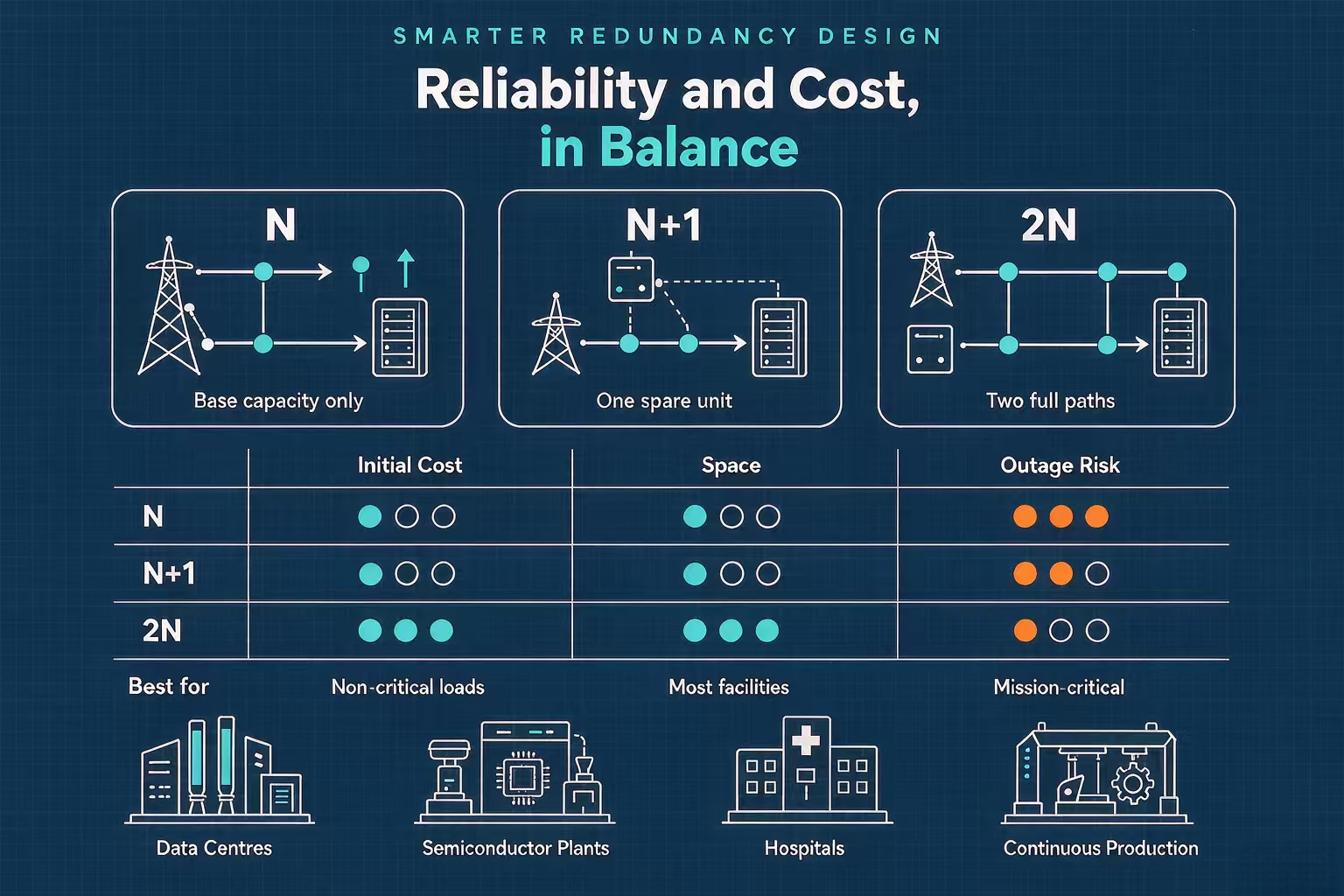
Electrical redundancy generally follows several design approaches. An N configuration provides exactly the capacity required by the expected load, without additional redundant components. N+1 introduces one additional component to tolerate an individual component failure or allow maintenance. A 2N arrangement provides two independent power paths, each capable of supporting the entire critical load.
A recent 2026 analysis based on more than 1,200 data-centre survey respondents found a measurable relationship between redundancy and outage exposure. Compared with N configurations, N+1 power arrangements were associated with approximately 23% lower likelihood of a financially impactful outage over three years, while the reduction reached approximately 44% for 2N systems. These are survey-based associations rather than guaranteed improvements for individual facilities. (Uptime Institute, October 2026)
Coordinating UPS, Switchgear and Backup Generation
A reliable power architecture requires more than duplicated equipment. Utility supplies, transfer switches, UPS systems, distribution switchgear and standby generators must operate as a coordinated system.
Protection selectivity is particularly important because a fault in one branch should not unnecessarily disconnect healthy sections. Automatic transfer sequences must also account for generator starting time, UPS battery autonomy and load restoration priorities. Identifying shared components, such as common busbars or control power supplies, is essential because these can become single points of failure even in otherwise redundant installations.
Balancing Investment, Space and Operational Efficiency
Higher redundancy generally requires additional equipment, installation space, cabling and maintenance resources. It can also increase auxiliary consumption and introduce more complicated switching arrangements. Consequently, 2N architecture may be appropriate for certain mission-critical loads, while N+1 or selectively redundant configurations may provide a more proportionate solution for other facilities.
The decision should consider the financial consequences of downtime, allowable interruption duration, maintenance requirements and the time needed to restore service.
Risk-Based Design Shapes Future Electrical Infrastructure
The development of modern electrical infrastructure is moving toward more detailed reliability assessments rather than relying on standardized redundancy levels alone. Load classification, failure-mode analysis, protection coordination and maintenance planning are becoming essential parts of project engineering.
Ultimately, effective redundancy design is not about maximizing the number of backup devices. It is about identifying critical failure scenarios, preventing common-mode failures and allocating investment according to operational risk. This approach allows facilities to balance electrical reliability with long-term infrastructure costs.