



Busway Systems Evolve as AI Drives a New Era of Power Density
AI Infrastructure Raises the Bar for Power Distribution
The rapid expansion of artificial intelligence is creating a new set of requirements for electrical infrastructure, particularly in data centres. Higher-performance computing systems are increasing rack power density while making load patterns more dynamic. The International Energy Agency estimates that global data-centre electricity consumption reached around 415 TWh in 2024 and could more than double to approximately 945 TWh by 2030. Electricity use by AI-driven accelerated servers is projected to grow by about 30% annually over the same period.
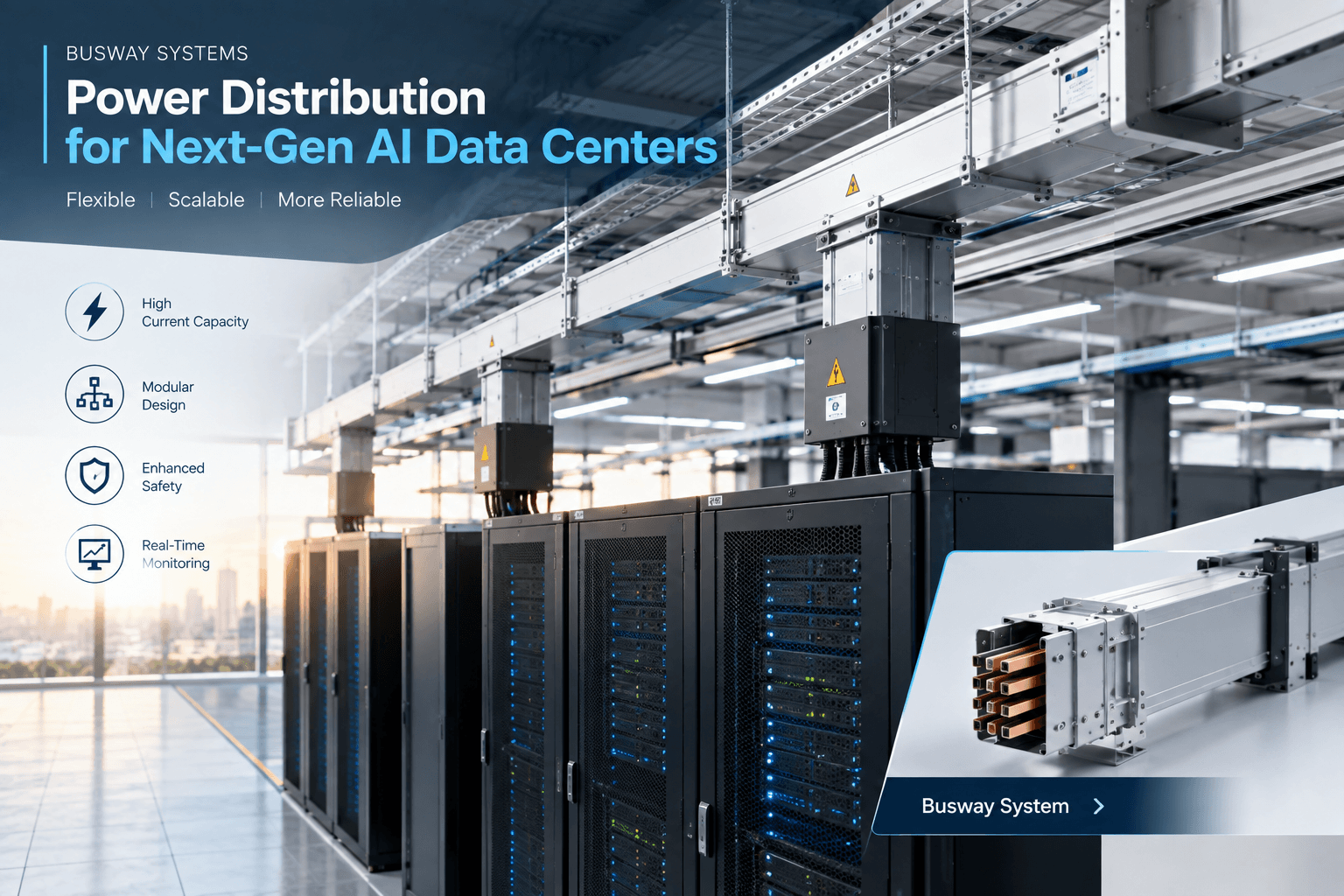
Against this background, the Busway is being reconsidered as an important power-distribution option for high-density computing environments.
Higher Rack Density Changes Distribution Architecture
AI workloads are pushing electrical designers to reconsider how power is delivered from upstream equipment to individual racks. The 2025 Uptime Institute Global Data Center Survey found that the average modal rack density had risen to almost 9 kW, compared with 8.3 kW in 2024, while racks in the 10–30 kW range continued to gain adoption.
For higher-density halls, a Busway can offer a modular route for distributing electricity along rows of equipment, allowing connection points to be added or relocated as rack layouts change. Compared with fixed cabling arrangements, this architecture can provide greater flexibility during phased expansion and equipment replacement.
Intelligent Monitoring Becomes Part of System Evolution
The development of Busway systems is also increasingly linked with digital monitoring. Current designs can incorporate measurement of current, voltage, temperature and other operating parameters, providing facility operators with more detailed information about distribution performance. This is particularly relevant for AI environments, where rapid changes in computing workloads can create sudden shifts in electrical demand.
Recent technical analysis notes that AI training clusters can produce synchronized load changes that create power-quality challenges for data-centre distribution systems. Monitoring and protection functions can therefore become important considerations when selecting distribution architecture for high-density computing.
From Fixed Capacity to Scalable Power Infrastructure
Future development is likely to focus on higher current capacity, improved thermal performance, modular tap-off units and greater digital visibility. Uptime Institute also notes that some next-generation AI facilities are considering larger conductors and higher-voltage distribution as rack densities increase, illustrating the broader shift in data-centre electrical design.
For electrical-system designers, the evolution of the Busway is therefore less about a single product upgrade and more about adapting power distribution to changing computing densities, expansion schedules and operational data requirements. Its future role will depend on how effectively the system balances capacity, flexibility, safety and lifecycle efficiency.